The liquidation happened at the end.
The mistake happened earlier.
The trade looked active. The chart was moving. The setup did not look completely random. The trader opened a leveraged position and expected price to continue.
Then the market pulled back.
Not a crash.
Not a full reversal.
Just enough movement against the position.
The margin warning appeared. The liquidation price came closer. The trader waited, hoped, and then the position was forced closed.
That is what most traders remember.
The liquidation.
But liquidation is usually not the first problem.
It is the final result of a trade that was already fragile.
A trader does not get liquidated only because price moved against them. Price always moves against entries sometimes. Liquidation happens because the position did not have enough room to survive that movement.
The real failure usually starts with one of these:
- the entry was late
- the position size was too large
- leverage was chosen before risk
- invalidation was unclear
- liquidation distance was too close
- the trader used margin as the risk plan
Getting liquidated in crypto is not only a bad outcome.
It is a risk design failure becoming visible.
This article is for educational purposes only. It does not provide financial advice, trading signals, or guaranteed trading results.
Liquidation Is the Last Event in the Chain
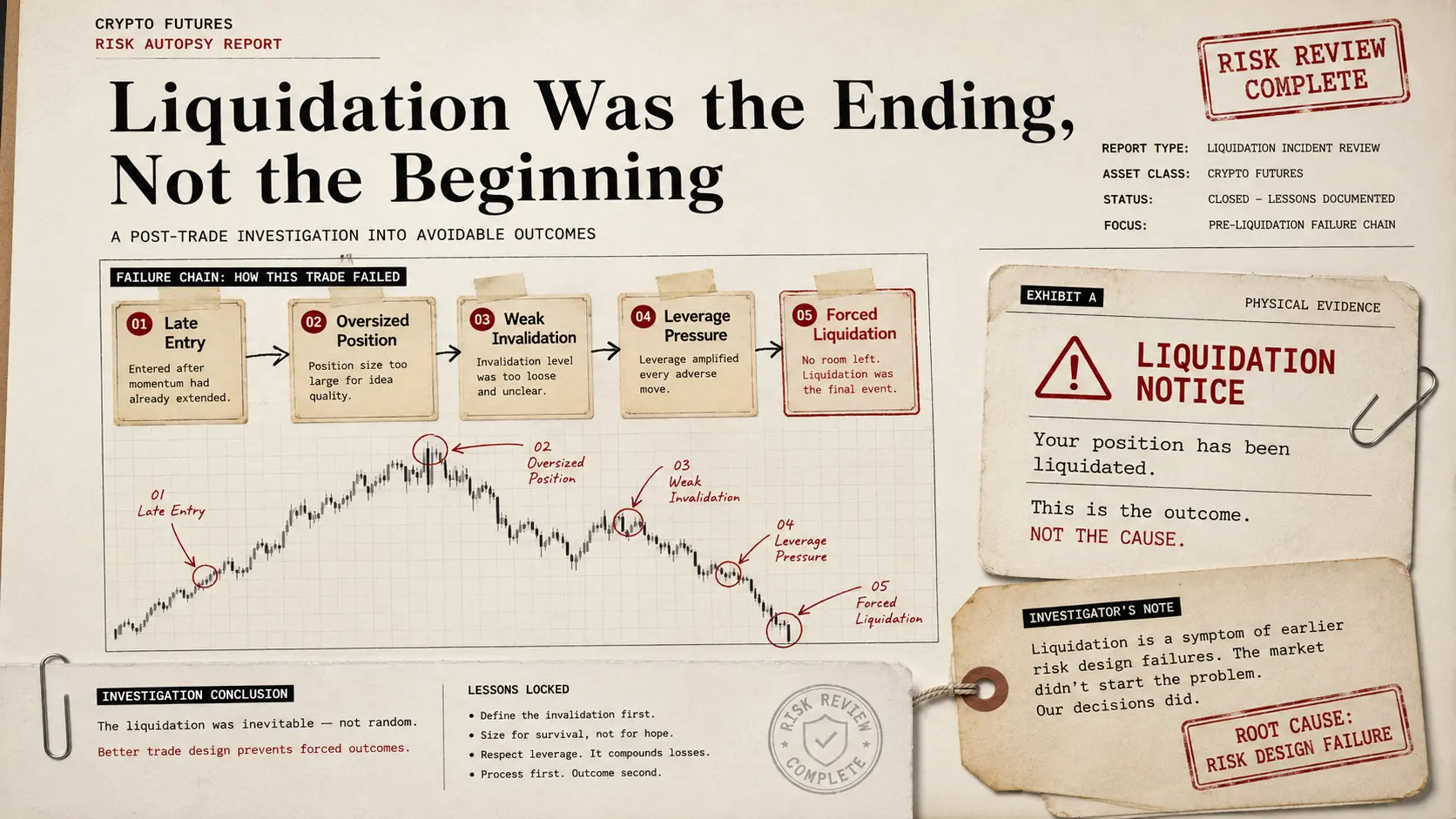
Liquidation feels sudden because it happens quickly.
The position is open.
Price moves.
Margin falls.
The forced exit happens.
But the chain starts before that.
The trader usually builds the problem before entry. The position is opened with too much exposure, too little room, or no clear invalidation. The liquidation price is already sitting too close to normal volatility.
At that point, the trade does not need a disaster to fail.
It only needs ordinary crypto movement.
This is why liquidation can feel confusing. The trader may look at the chart and think the market did not move that much. The setup may not even look completely dead.
That is the point.
The trade idea and the leveraged position are not the same thing.
The idea may still be alive.
The position may already be too fragile.
Liquidation happens when the position cannot survive the path the market takes, even if the broader idea was not impossible.
The Trade Was Too Fragile Before Price Moved
A strong trade has room.
A fragile trade does not.
A fragile leveraged trade may look normal at entry. The candle looks clean. The direction feels reasonable. The margin required looks affordable.
But under the surface, the position is already weak.
The liquidation distance is too close. The size is too large. The invalidation level is farther away than the position can survive. A small move against the entry creates pressure immediately.
That is not bad luck.
That is structure mismatch.
The trade needs more room than the position allows.
If the real question is how much the account can lose when leverage, slippage, and liquidation distance stack together, read How Much Can You Lose Trading Crypto With Leverage?. That article breaks down why the margin box is not the full danger.
This happens often in crypto futures because leverage makes the position feel smaller than it really is. The trader sees the margin used, not the full exposure. The trade looks manageable until price moves against it.
Then the real position appears.
A fragile trade is not exposed when liquidation happens.
It is exposed when the first normal pullback creates panic.
Late Entries Make Liquidation Easier
Late entries are one of the fastest paths to liquidation.
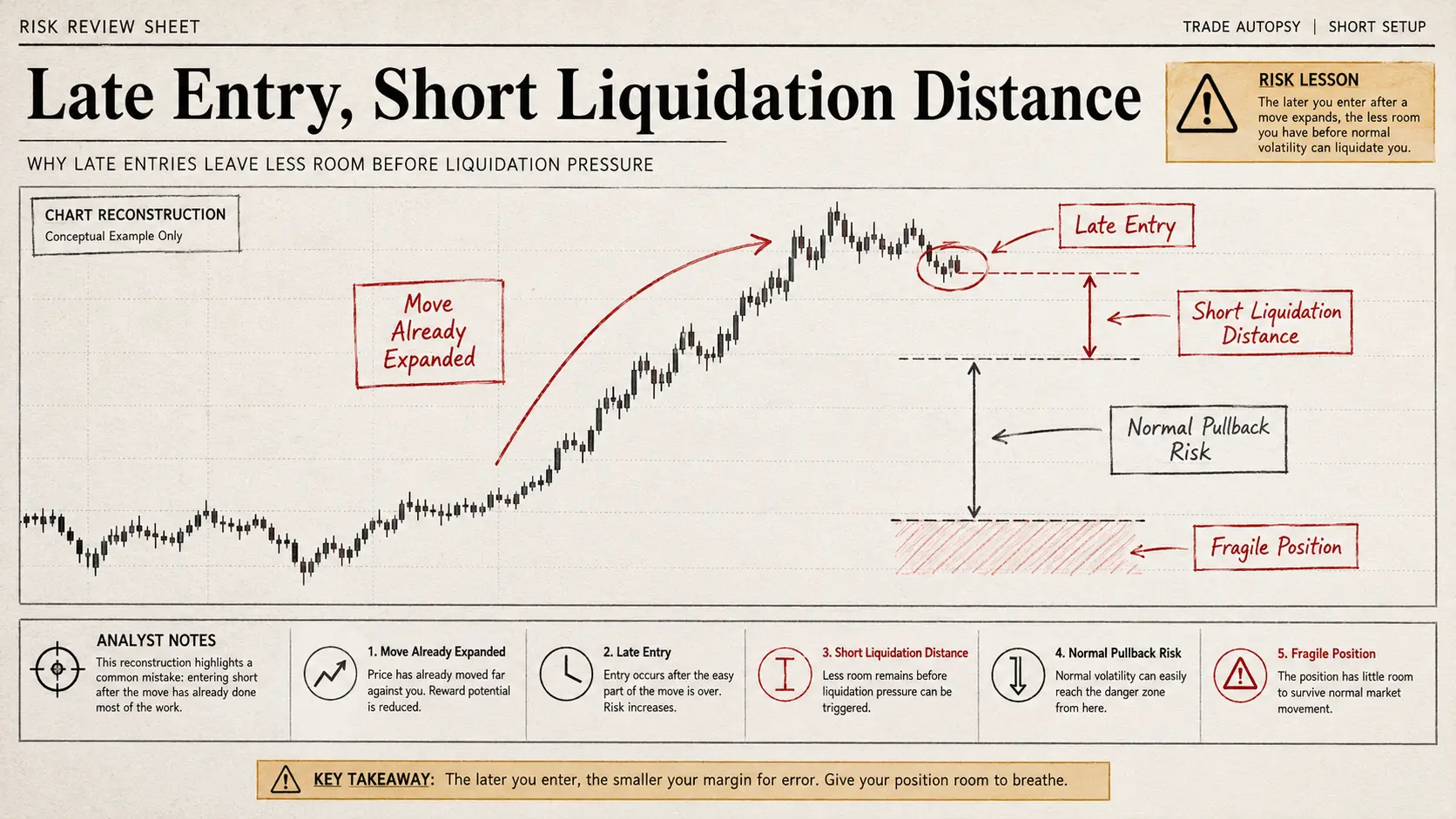
The market moves first. The candle expands. The trader enters after the move already looks obvious.
At that point, the entry is far from the clean structure.
The important level is farther away.
The invalidation distance is wider.
The room for price to continue may be smaller.
To make the trade feel worthwhile, the trader often increases leverage or size.
That is where the trap forms.
A late entry already has worse risk.
Leverage makes it more sensitive.
The position now needs the market to continue almost immediately. If price pauses, retests, or snaps back, the trader feels pressure quickly.
The market does not need to be wrong.
The timing only needs to be bad.
Many crypto liquidations are not caused by one huge move. They are caused by entering late with a position that cannot survive a normal correction.
Liquidation Is Not the Same as Being Wrong
A trader can be liquidated before the market fully proves the idea wrong.
That is one of the most painful parts of futures trading.
Price may wick into a retest area.
Price may pull back before continuation.
Price may move through normal noise.
The trade idea may still have a structure argument.
But if liquidation is too close, the position cannot wait.
The exchange closes it.
This is why liquidation should never replace invalidation.
Invalidation is where the trade idea fails.
Liquidation is where margin fails.
Those are different events.
A trader should exit because the market structure proves the idea wrong, not because the exchange forces the position closed.
When liquidation sits before invalidation, the trade is badly built.
To separate forced liquidation from a planned exit, read Crypto Liquidation vs Stop Loss. That article explains why a stop loss is voluntary, while liquidation is the platform taking control away from the trader.
The position can die before the idea is judged.
Leverage Does Not Give the Trade More Edge
Leverage makes the position larger.
It does not make the setup better.
It does not improve timing.
It does not create structure.
It does not move invalidation closer in a professional way.
It only changes how much pressure a price move creates.
A trade with weak structure becomes more dangerous with leverage. A late entry becomes more fragile with leverage. An oversized position becomes easier to liquidate with leverage.
This is why traders often feel confused after liquidation.
They believe they were trading the chart.
But they were really trading a leveraged exposure that was too sensitive for the chart.
The setup needed space.
The position had pressure.
The market moved normally.
The account could not survive it.
That is leverage doing exactly what leverage does.
It magnifies the consequence of the position design.
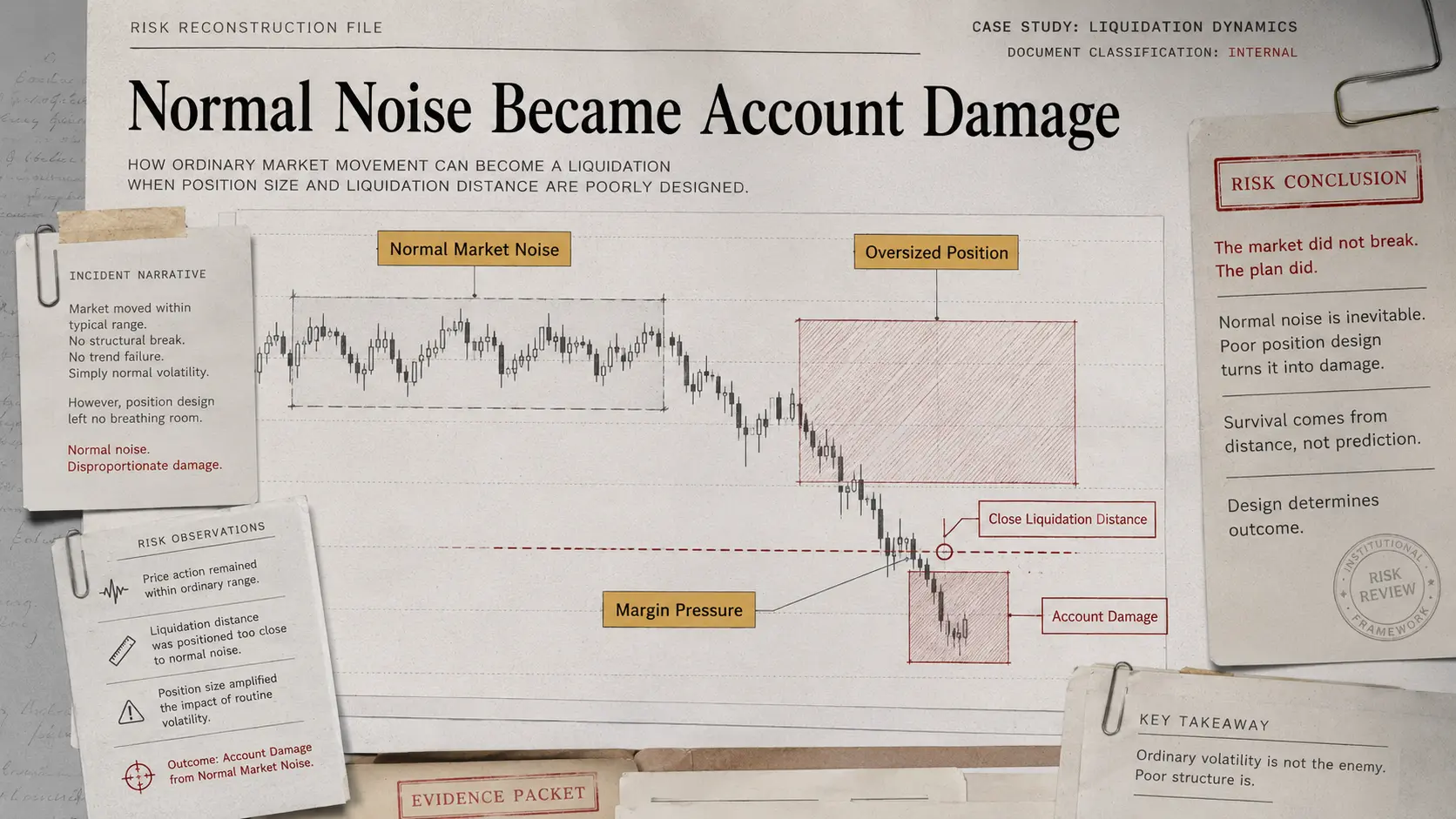
Oversized Position Size Turns Noise Into Damage
Position size controls how much the account feels each move.
When the size is too large, every candle becomes emotional. A small pullback feels like a threat. A normal wick feels like danger. The trader stops reading structure and starts watching margin.
This is how liquidation pressure takes over.
The trader may add margin without a plan.
They may widen risk.
They may refuse to close because the loss feels too large.
They may wait for a bounce that never comes.
The original trade plan disappears.
The position size becomes the problem.
A properly sized trade can take a normal pullback without forcing emotional decisions. An oversized trade turns normal movement into account stress.
Liquidation often begins as a sizing mistake.
The forced exit is only the final confirmation.
The Warning Signs Were There Before Liquidation
Liquidation usually gives warnings before it happens.
The position feels too sensitive.
A small move creates too much unrealized loss.
The trader checks margin more than structure.
The liquidation price feels close.
The trader starts hoping instead of managing.
These signs mean the trade is already emotionally compromised.
A strong futures trade should not require perfect market behavior to survive. It should have enough room for ordinary volatility, retests, and wicks.
If the position becomes dangerous during a normal pullback, the problem is not the pullback.
The problem is the position.
This is where many traders misunderstand risk. They blame the market for moving against them. But the market is allowed to move. The position must be designed for that.
A trade that cannot handle normal movement is not a strong trade.
It is a forced exit waiting for a reason.
After Liquidation, the Next Trade Is the Dangerous One
The trade after liquidation is often more dangerous than the liquidation itself.
The trader wants the money back.
The chart is still open.
The market is still moving.
The emotional pressure is high.
This is where liquidation turns into revenge trading.
A trader who immediately re-enters after liquidation is no longer reading from a neutral state. They are trying to repair damage. That changes how they see the chart.
Weak setups look stronger.
Late entries feel urgent.
Large size feels justified.
Leverage feels like a way to recover faster.
That is how one liquidation becomes a larger loss cycle.
If the next trade after liquidation starts to feel urgent, read Revenge Trading Crypto. That article explains how one loss can turn into an emotional recovery cycle after the trader tries to win the money back too quickly.
After liquidation, the first rule is not to find the next entry.
The first rule is to stop the damage from spreading.
The account needs a reset before another leveraged decision.
A Better Way to Read Liquidation Risk
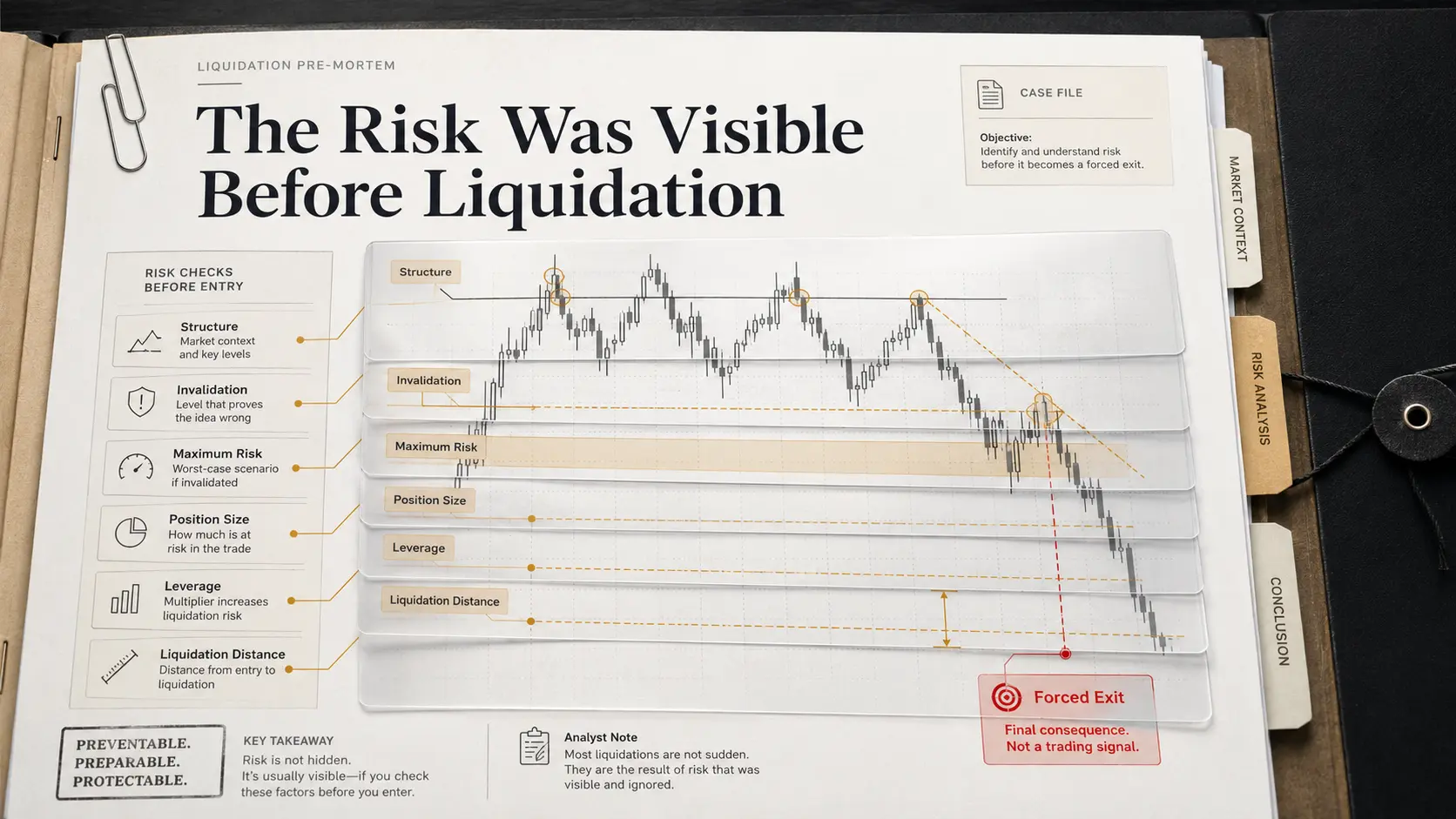
Liquidation risk should be checked before the trade exists.
The trader starts with structure.
The structure defines invalidation.
Maximum account risk defines how much can be lost.
Position size is calculated from that risk.
Leverage is adjusted after size is known.
Liquidation distance is checked before entry.
This sequence prevents the exchange from becoming the risk manager.
If liquidation is too close, the position is reduced.
If size is too large, the trade is resized.
If invalidation is unclear, the trade is rejected.
If leverage makes the trade fragile, leverage is lowered.
The goal is not to avoid every losing trade.
The goal is to avoid being forced out before the trade idea has a fair chance to play out.
A liquidation calculator can help, but only if the trader uses it before entry.
After entry, it becomes a stress monitor.
Before entry, it is a risk filter.
Before rebuilding another leveraged position, define the maximum account risk first:
Open the Maximum Risk Calculator
The Final Rule After Getting Liquidated
Getting liquidated does not mean the trader is finished.
But it does mean the risk process failed somewhere.
The answer is not to take the next trade faster.
The answer is to find where the position became fragile.
The entry may have been late.
The size may have been too large.
The leverage may have been chosen first.
The invalidation may have been unclear.
The liquidation distance may have been too close.
The trader may have treated margin as a risk plan.
Liquidation is painful because it feels like the market made the final decision.
But the position was built before the market made that decision.
A stronger process starts before entry.
Define the structure.
Define invalidation.
Define maximum loss.
Size the position.
Check liquidation distance.
Only then decide whether the trade deserves to exist.
In crypto futures, liquidation is not just something that happens at the end.
It is something that becomes possible the moment risk is built wrong.